
Do you want to learn how to configure WordPress for eCommerce tracking? You may discover your best-selling products, observe which marketing efforts are most effective, learn how visitors arrive at and use your website, and more by setting up eCommerce tracking for your online store. Following that, you may use those insights to increase traffic and sales.
In this article, we’ll demonstrate how to correctly set up eCommerce tracking in WordPress so you can expand your company and generate more revenue.
Why Install eCommerce Tracking for WordPress?
Most online store owners start off by making choices based on intuition or educated assumptions when opening a new business.
That’s fine for getting started, but to further your company’s growth, you must begin using data to guide your decisions.
What information, though, should you use to inform your choices?
WordPress eCommerce tracking can help with that. It assists you in making judgments based on information from genuine visitors and clients. You’ll receive personalized insights to increase sales and increase your income.
For instance, you may learn which goods are the most popular purchases on your WooCommerce store. In this manner, you can market comparable goods to increase sales.
Additionally, eCommerce tracking in WordPress can help you gain a deeper understanding of your audience, their origins, and how they use your website, allowing you to allocate more resources to those channels and tactics that have been shown to be effective.
For instance, you might opt to invest in Facebook ads and forgo spending time on other social media platforms like Twitter if you learn that 80% of course sales on your membership site originate from Facebook.
After that, let’s look at how to monitor the effectiveness of your WordPress eCommerce store.
WordPress eCommerce Tracking Configuration
Utilizing MonsterInsights is the simplest approach to monitor the success of your online store. More than 3 million experts use it, making it the finest analytics WordPress plugin.
You may set up eCommerce tracking in Google Analytics with the aid of MonsterInsights. Several of the most well-liked eCommerce plugins are compatible with the extension, including WooCommerce, Easy Digital Downloads, LifterLMS, MemberPress, LifterLMS, GiveWP, and more.
The nicest benefit of utilizing MonsterInsights to measure eCommerce conversions in WordPress is that you don’t need to alter code or employ a developer.
This is due to the fact that using Google Tag Manager or altering the tracking code is required for the manual setup of eCommerce tracking in Google Analytics.
These two approaches are challenging and intimidating for newcomers. Your analytics and data could be messed up if a setup error is made.
In situations like this, MonsterInsights is useful. It provides an eCommerce module that sets up eCommerce tracking automatically on your WordPress website.

Additionally, it displays significant statistics in your WordPress admin area so you can immediately see how your website is operating and get knowledge to expand your business.
Note: that the eCommerce addon, dashboard reports, and other sophisticated tracking capabilities are only available in the MonsterInsights Pro version. You can also utilize the MonsterInsights Lite edition to begin going.
After activation, your WordPress dashboard will open to the MonsterInsights welcome screen. Select “Launch the Wizard” and click it now.

After that, adhere to the instructions in the wizard to configure the plugin and link your website to Google Analytics.
The next step is to use your WordPress dashboard to go to Insights » Addons. Next, click the ‘Install’ button next to the eCommerce addon in the lower right corner.
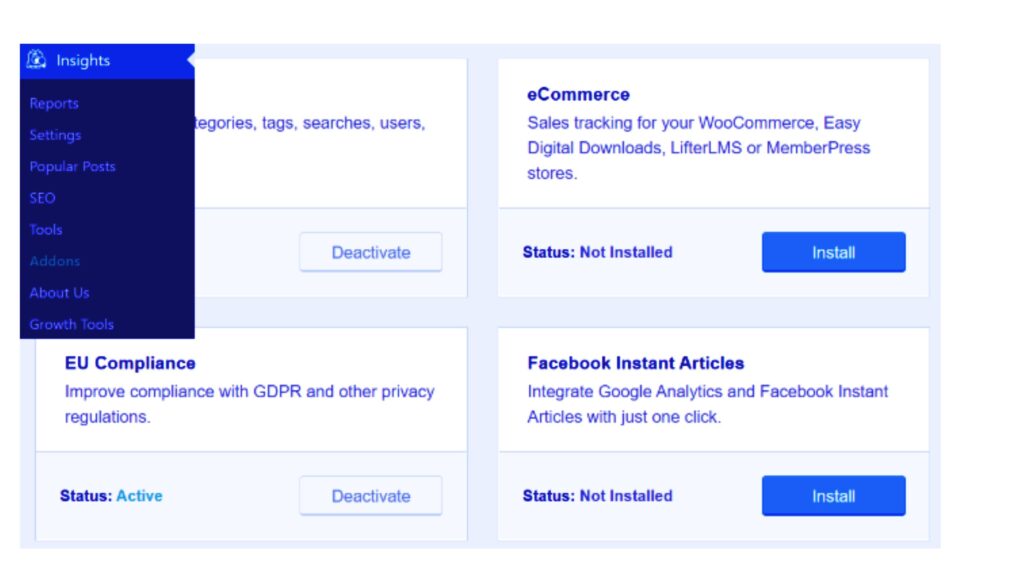
You’ll notice that the status has changed to “Active” and that the add-on will automatically activate.
Simply select the ‘eCommerce’ tab by going to Insights » Settings after that.
The ‘Use Enhanced eCommerce’ option under the eCommerce tracking section must then be turned on

As of right now, MonsterInsights will recognize your WordPress eCommerce plugin and begin collecting metrics.
Let’s now examine how you may use MonsterInsights’ reports to assess the performance of your online store.
Visit WordPress to view eCommerce Reports
It can be overwhelming for beginners to use Google Analytics and locate the data they require.
By bringing all of your crucial numbers inside the WordPress dashboard, MonsterInsights makes it incredibly simple to get the information that counts. You can then decide how to expand your business after assessing how well your eCommerce store is functioning.
Go to Insights » Reports in WordPress to view eCommerce reports. You can do this by clicking the ‘eCommerce’ menu and then selecting Overview.
Also Read: How to Integrate Web Push Notifications Into Your WordPress Website
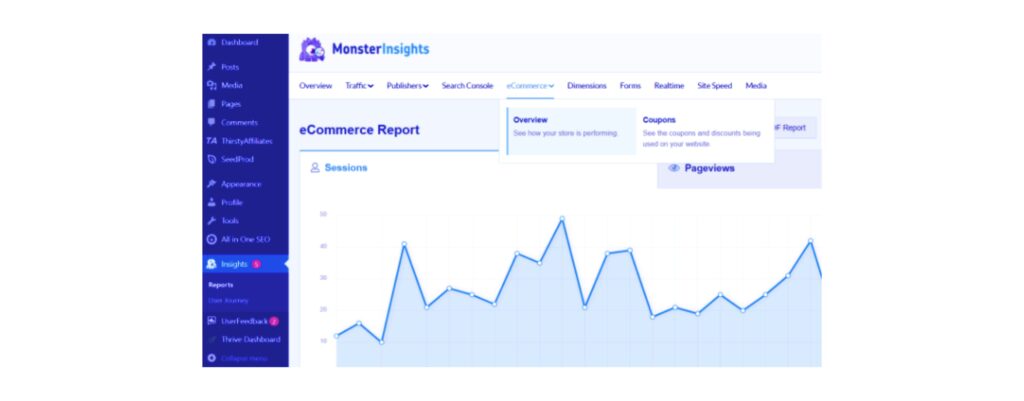
You may easily assess the performance of your online store by reviewing the report’s conversion rate, transactions, revenue, and average order value.
Additionally, MonsterInsights displays a list of your Top Products. It enables you to identify your best-selling products and their quantity, sales percentage, and overall revenue.

You can use this information to determine which products your clients prefer and then provide alternatives to increase sales.
The Top Conversion Sources can then be shown by descending further.
The majority of your store’s sales are coming from these websites. You may spend money on advertisements on those websites, designate specific discounts or free shipping for customers who come from those sources or get in touch with them to arrange a cross-promotion or other type of collaboration.
The Total Add to Carts, Total Removed from Carts, New Customers, and Abandoned Checkouts are some of the additional reports available in the eCommerce part of MonsterInsights.

These reports might help you better comprehend how your customers behave as they shop and check out. Additionally, using the data to improve your sales funnel and lower cart abandonment is beneficial.
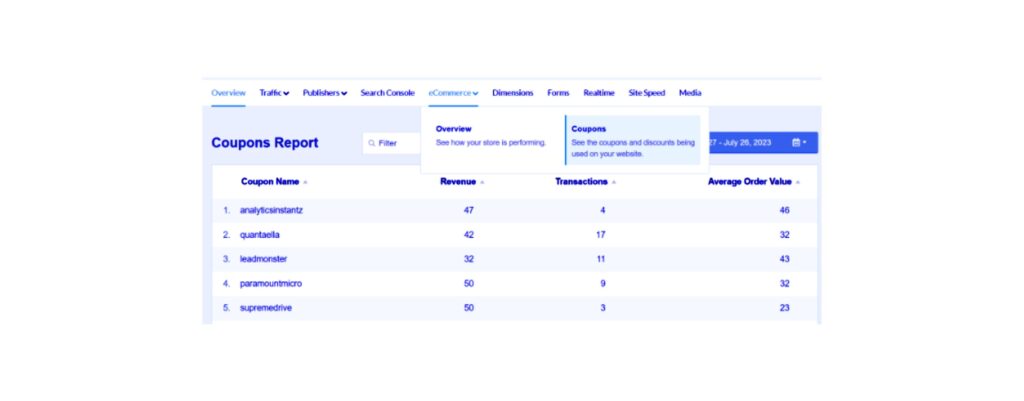
In addition, you can access MonsterInsights’ eCommerce » Coupons report. This report will reveal how customers engage with promo codes if your online store offers them.
You may view the average order value, which coupons generate the most sales, and other information on your website.
Go to Google Analytics to view eCommerce reports.
Finding the information you need to make decisions is quite simple with MonsterInsights. However, your Google Analytics account also allows you to monitor eCommerce tracking.
Let’s look at how Google Analytics 4 (GA4) and Universal Analytics display eCommerce reports.
Reports for eCommerce in Google Analytics 4
The most recent iteration of Google’s well-known analytics tool is called Google Analytics 4. The data from your online store can be found in many reports because it makes use of a new reporting interface.
You must sign into your Google Analytics account first. Just select Reports » Monetization » Overview from the menu on the left after that.
Also Read: Beginner’s Guide on How to Install Google Analytics in WordPress
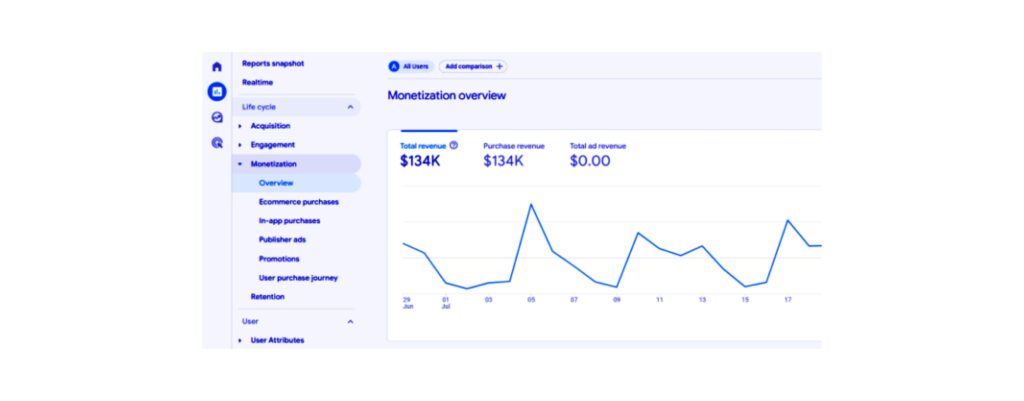
You may quickly assess the performance of your store here. Metrics like total revenue, purchase revenue, total buyers, average purchase revenue per user, and more are displayed by Google Analytics.
In addition, you may view product performance by going to Monetization » Ecommerce transactions. Data from GA4 will include information on the products that received the most views, the most purchases, and a breakdown of income by product.
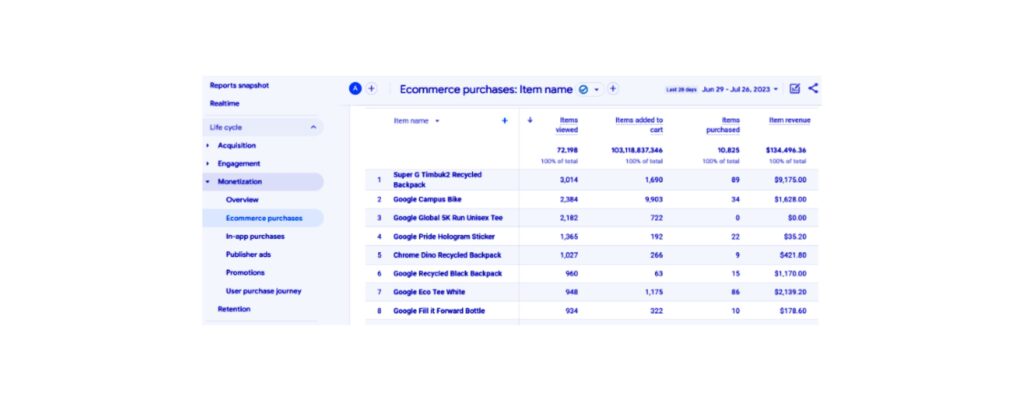
You can browse additional reports in Google Analytics to discover information about eCommerce tracking.
If you have an app, for instance, you may check the “In-app purchases” report to discover what goods your users purchased through the app. The ‘Publisher advertisements’ report also allows you to assess the success of your paid advertising campaigns.
Google Analytics displays a “User purchase journey” report if you wish to see your customers’ purchasing journeys. You can check how many visitors started a session and then proceeded to purchase your product here.
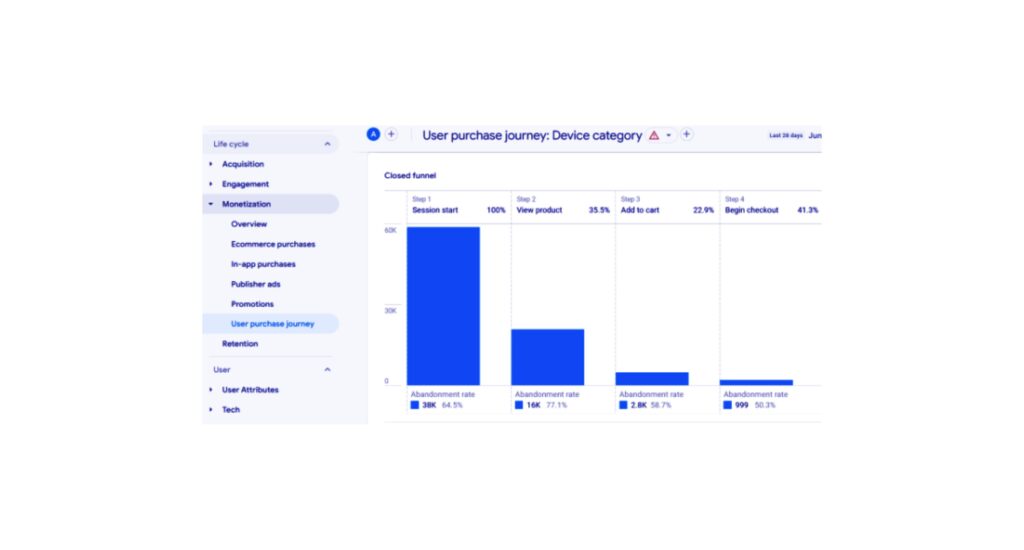
You may utilize this knowledge to try to increase conversions by simplifying the purchasing process since the report also includes the abandon rate for each step.
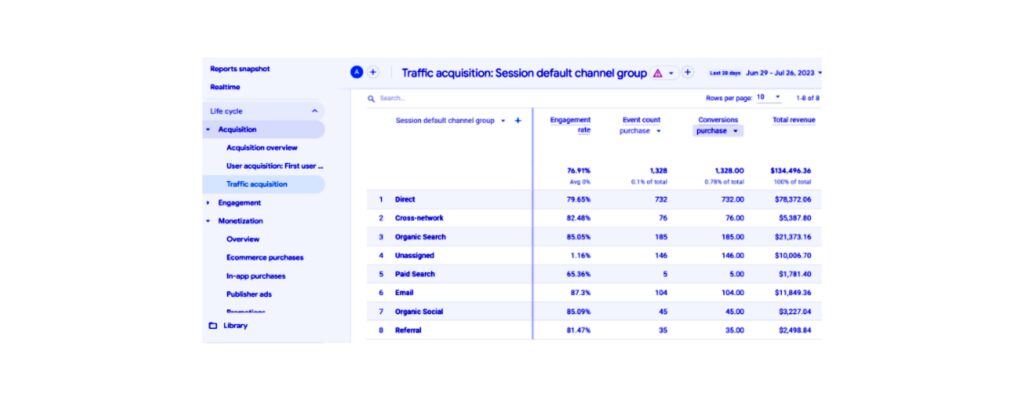
You may combine Google Analytics statistics with others, such as traffic acquisition reports, to get the most out of them and determine which channel brings in the most money.
Reports for eCommerce in Universal Analytics
Note: Universal Analytics was a previous version of Google Analytics and is no longer supported. Your website’s data will no longer be processed and recorded. However, Universal Analytics still lets you access your previous eCommerce data.
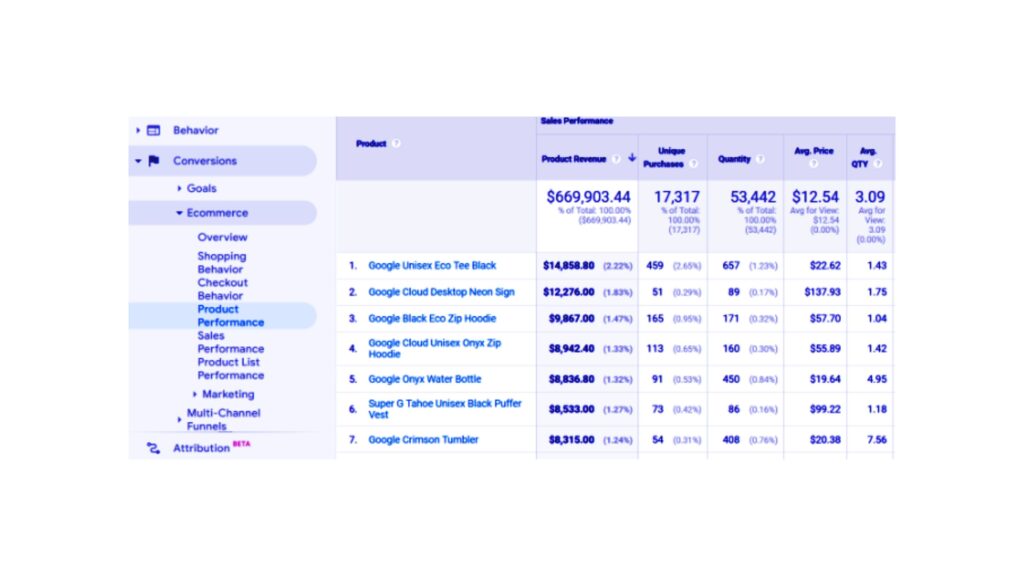
You can select Conversions Ecommerce Overview from the menu on the left to view eCommerce reports.
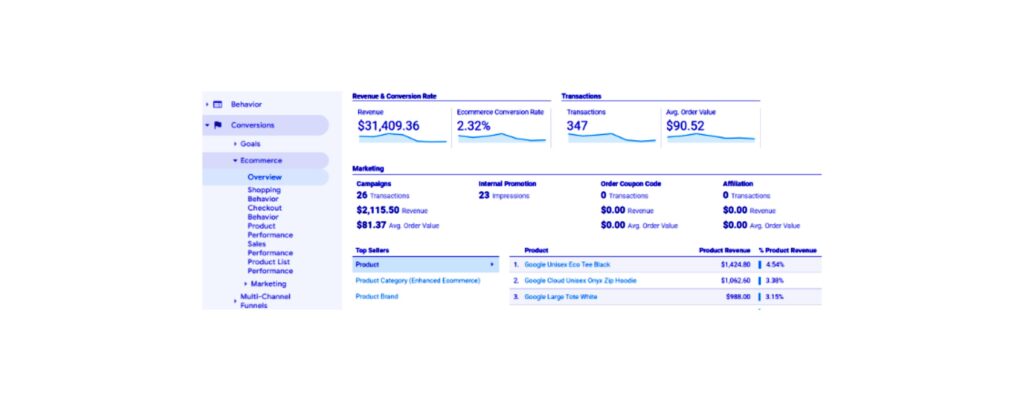
In this report, Universal Analytics will provide a summary of several metrics.
To access information on purchasing habits, product performance, sales performance, and other topics, you can switch to other reports.
Also Read: How to Use WordPress to Host Online Events
Bonus: Turn on Google Analytics’ customer tracking feature.
After establishing eCommerce tracking, you can advance and enable customer tracking.
You will be able to comprehend each customer in your store better as a result. For users who have signed in, you can provide a customized shopping experience, highlight popular products, and increase sales.
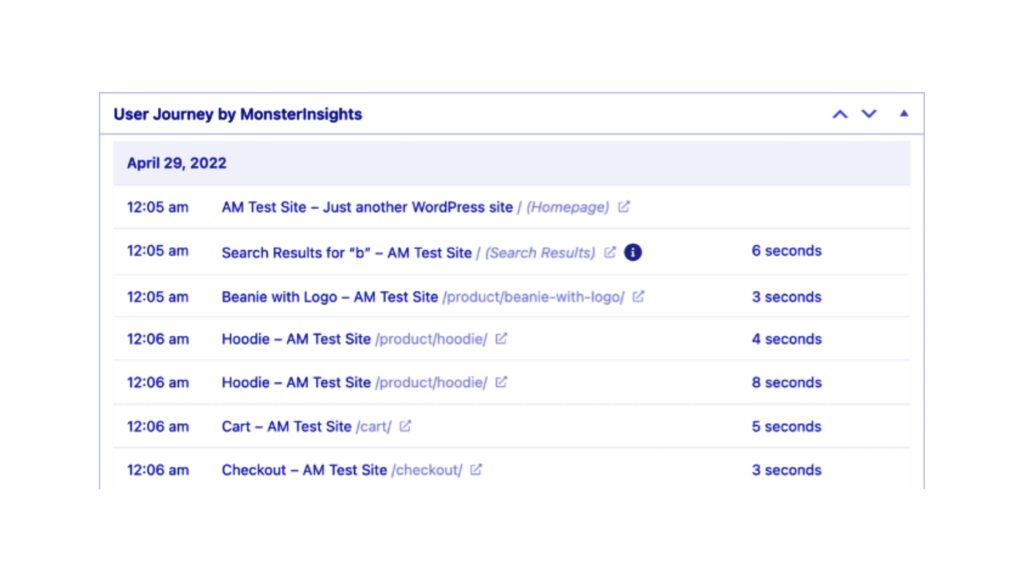
Utilizing MonsterInsights’ User Journey addon, you can quickly set up customer tracking. It will display all the actions a consumer took prior to completing a purchase, including the pages they viewed, the searches they conducted on your website, the links they clicked, and more.
We hope this article helped you learn how to set up eCommerce tracking in WordPress.